What is the meaning of yield curve?

Christopher Harper
Published Jan 20, 2026
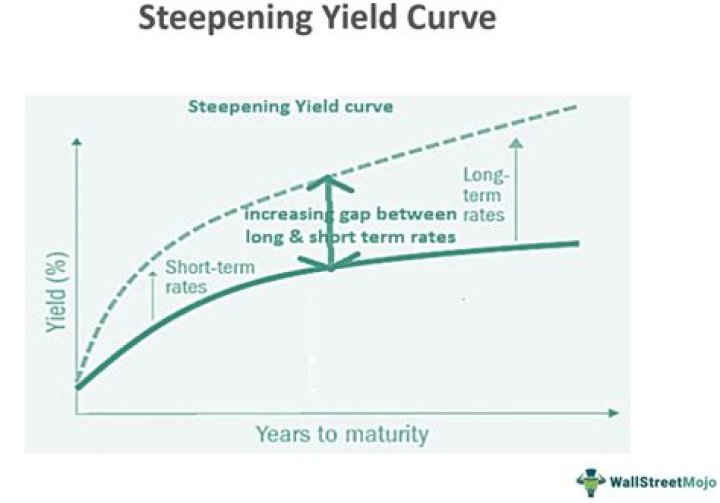
A yield curve is a line that plots yields (interest rates) of bonds having equal credit quality but differing maturity dates. The slope of the yield curve gives an idea of future interest rate changes and economic activity.
How do you interpret the yield curve?
The yield curve is a curve on a graph in which the yield of fixed-interest securities is plotted against the length of time they have to run to maturity. A yield curve is almost always upward sloping, a sign that the economy is functioning properly.
What does the yield curve say about the economy?
Yield curve, in economics and finance, a curve that shows the interest rate associated with different contract lengths for a particular debt instrument (e.g., a treasury bill). It summarizes the relationship between the term (time to maturity) of the debt and the interest rate (yield) associated with that term.
What is the yield curve risk?
The yield curve risk is the risk of experiencing an adverse shift in market interest rates associated with investing in a fixed income instrument. When market interest rates, or yields, increase, the price of a bond will decrease, and vice versa.
Who sets the 10 year yield?
When setting the Federal Funds Rate, the Federal Reserve. takes into account the current 10-year Treasury rate of return. The yield on the 10-Year Note is the most commonly used Risk-Free Rate for calculating a company’s Weighted Average Cost of Capital (WACC)
How does yield curve behave in risk?
Interest rates and bond prices have an inverse relationship in which prices decrease when interest rates increase, and vice versa. Therefore, when interest rates change, the yield curve will shift, representing a risk, known as the yield curve risk, to a bond investor.
Are higher bond yields good or bad?
High yield bonds are not intrinsically good or bad investments. Generally, a high yield bond is defined as a bond with a credit rating below investment grade; for example, below S&P’s BBB. The bonds’ higher yield is compensation for the greater risk associated with a lower credit rating.
What does it mean to be on the yield curve?
Bond Investors will sometimes hear the term “yield curve.”. The yield curve is a graphic illustration (plotted on a graph) showing the yields on bonds of varying maturities—typically from three months to 30 years.
When did the 20 year Treasury yield curve end?
As a result, there are no 20-year rates available for the time period January 1, 1987 through September 30, 1993. Treasury Yield Curve Rates: These rates are commonly referred to as “Constant Maturity Treasury” rates, or CMTs.
Which is an example of an inverted yield curve?
Such instruments include government-backed T-bills, corporate bonds, private debt agreements, and other fixed income securities. An inverted yield curve occurs due to the perception of long-term investors that interest rates will decline in the future.
Is it possible for the yield curve to flatten?
Conversely, the yield curve can flatten, which means that short-term rates are rising faster than long-term rates (thus indicating outperformance for long-term bonds relative to short-term issues). Very rarely, the yield curve can be inverted.