What does mean plus or minus standard deviation mean?

Sarah Martinez
Published Jan 20, 2026
The square root of the variance is called the standard deviation, usually denoted by s. It is often abbreviated to SD. Because standard deviation is a measure of variability about the mean, this is shown as the mean plus or minus one or two standard deviations.
What are the mean and standard deviation for the standard normal distribution?
The standard normal distribution is a normal distribution with a mean of zero and standard deviation of 1. For the standard normal distribution, 68% of the observations lie within 1 standard deviation of the mean; 95% lie within two standard deviation of the mean; and 99.9% lie within 3 standard deviations of the mean.
What do you call plus and minus signs?
The plus–minus sign, ±, is a mathematical symbol with multiple meanings. In mathematics, it generally indicates a choice of exactly two possible values, one of which is obtained through addition and the other through subtraction. The sign may also represent an inclusive range of values that a reading might have.
Can standard deviation be subtracted?
There is no reason to subtract SDs except for wanting to know how much larger one uncertainty is than the other. If your question is “How to compare u1 +/- SD1 to u2 +/- SD2? ‘ then you must use the method of propagation of error given Jochen. The SD is a measure of uncertainty.
Is standard deviation +-?
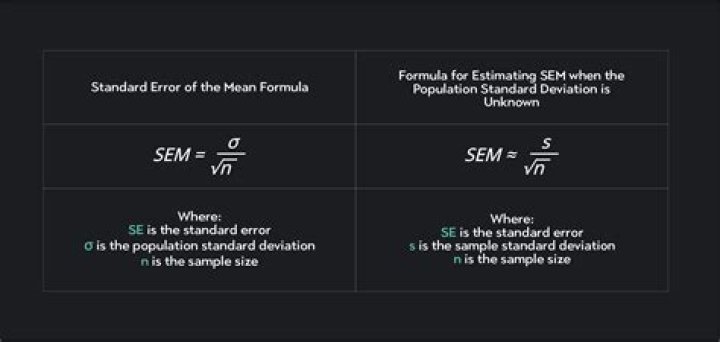
1 Answer. Yes! you can represent standard deviation as “±SD”. and, ˉx±2×SE of mean, shows lower and upper limit of population mean.
Is the mean plus or minus the standard deviation the same?
The cumulative probability up to the mean plus 1 standard deviation for a Normal distribution – not any distribution – is 84%. The reference is any table (or on-line version) of z-scores for the standard normal distribution. Is probability density function and gaussian distribution function are same?
What is the mean of a normal distribution?
Theoretically, a normal distribution is continuous and may be depicted as a density curve, such as the one below. The distribution plot below is a standard normal distribution. A standard normal distribution has a mean of 0 and standard deviation of 1. This is also known as the z distribution.
Is the 68-95-99.7 rule for a normal distribution?
The normal distribution is commonly associated with the 68-95-99.7 rule which you can see in the image above. 68% of the data is within 1 standard deviation (σ) of the mean (μ), 95% of the data is within 2 standard deviations (σ) of the mean (μ), and 99.7% of the data is within 3 standard deviations (σ) of the mean (μ).
How many observations fall within one standard deviation of the mean?
For example, in Lesson 2 we learned about the Empirical Rule which stated that approximately 68% of observations on a normal distribution will fall within one standard deviation of the mean, approximately 95% will fall within two standard deviations of the mean, and approximately 99.7% will fall within three standard deviations of the mean. [1]