How do you calculate tax-equivalent yield on a municipal bond?

Mia Phillips
Published Jan 20, 2026
Tax-equivalent yield = interest rate ÷ (1 – your tax rate) You would perform the following calculation if you want to know the real rate of return on a nontaxable municipal bond—the rate that would be equivalent on a taxable bond.
What is the taxable equivalent yield on a municipal bond?
The tax-equivalent yield is the return that a taxable bond would need to equal the yield on a comparable tax-exempt municipal bond. The calculation is a tool that investors can use to compare the returns between a tax-free investment and a taxable alternative.
What is the primary advantage of investing in a municipal bond?
Investing in municipal bonds is a good way to preserve capital while generating interest. Most of them are exempt from federal taxes, and some are tax-free at the state and local level as well. 1 Municipal bonds, also called munis, help build infrastructure in your area.
Why would a company want to call a bond?
A callable bond allows the issuing company to pay off their debt early. A business may choose to call their bond if market interest rates move lower, which will allow them to re-borrow at a more beneficial rate.
How do you calculate the yield on a municipal bond?
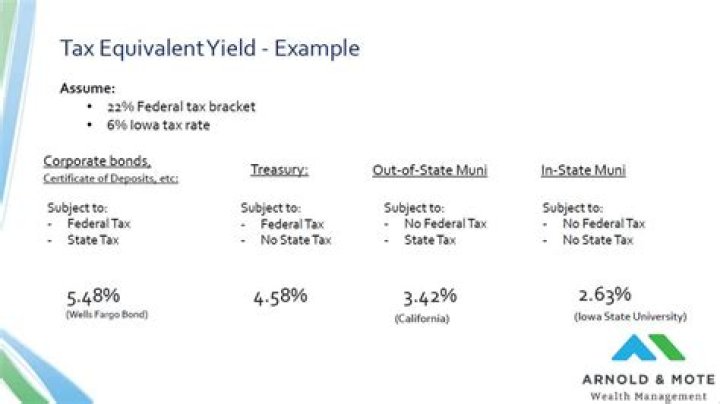
But first you need to calculate the after-tax yield of the municipal by multiplying it by 1 minus your state tax rate. The after-tax yield on a Treasury is obtained by multiplying its yield by 1 minus your federal tax rate. The after-tax yield on a fully taxable bond depends on whether you take that state income tax deduction.
How are municipal bonds different from taxable bonds?
To compare the yield on a municipal bond and a taxable bond, you have to calculate either the taxable-equivalent yield of the muni bond or the after-tax yield of the taxable bond. Looking to invest in bonds? Do your research on the various types first; a municipal bond is far different from a taxable bond.
How to calculate tax equivalent yield on Munis?
Tax equivalent yield (TEY) is the tool used to compare tax-free munis to taxable bonds. Most munis are tax-exempt on the federal and state levels, which sounds like a great deal at first. You don’t want to pay taxes on your investment income when you have the option not to. Unfortunately, though, it isn’t quite that simple.
How to calculate the tax equivalent yield on a bond?
The following shows how to calculate the tax-equivalent yield in a few steps: Find the reciprocal of your tax rate, or in other words, use (1 – your tax rate). If you pay 25 percent tax, for example, your reciprocal would be (1 -.25) =.75, or 75 percent. Divide this into the yield on the tax-free bond to find out the tax-equivalent yield.